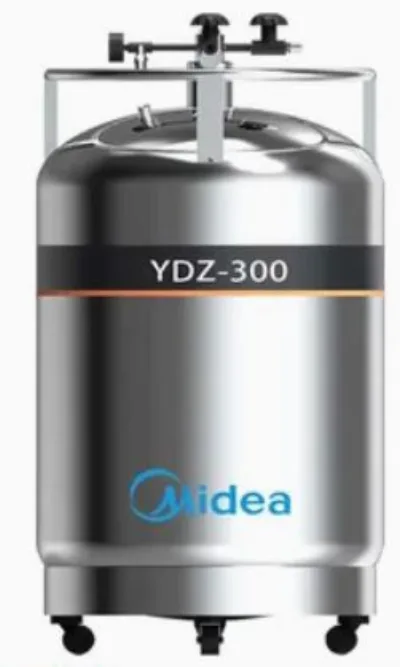
LN₂ storage tank, 200 l, for automatic or manual refilling of LN₂ containers
item number: 40650
complete with withdrawal valve assembly, mobile base frame, hand ring and withdrawal hose
Price on request

Liquid nitrogen storage tanks (LN2) are used for the stationary or mobile supply of cryogenic nitrogen in laboratories, clinics, and research facilities. These containers enable the manual or automatic refilling of sample storage containers and cryogenic systems. Specialized withdrawal devices ensure a controlled transfer of the medium for cryopreservation.
item number: 40650
Price on request
item number: 40379
Price on request
item number: 40545
Price on request
item number: 40438
Price on request
In biotechnology, pharmaceuticals, and medicine, the uninterrupted supply of liquid nitrogen is essential for the integrity of biological samples. An LN2 storage tank acts as a central supply unit. The containers are designed to keep evaporation rates low through vacuum-insulated walls while allowing easy withdrawal for daily needs.
The range includes storage containers with volumes from 100 liters, 200 liters, 300 liters up to 500 liters. Standard equipment usually includes a withdrawal manifold, a transfer hose, and a hand ring for safe maneuverability. An integrated caster base ensures mobility within laboratory rooms, allowing various withdrawal points to be reached flexibly.
The LN2 storage tanks are designed for different process requirements. They support both the manual filling of smaller dewar vessels and the automatic replenishment of large sample storage tanks. For models such as the 300-liter container, an operating pressure of 1.5 bar is specified, ensuring a stable transfer flow of the liquid nitrogen via the withdrawal lines.
Here you will find answers to technical and application-related questions regarding the storage of liquid nitrogen.
These tanks are used for storing liquid nitrogen (LN2) and are primarily used to manually or automatically refill other cryogenic containers or sample storage systems.
The range includes various capacities, including compact units with 100 liters as well as larger variants with 200, 300, or 500 liters capacity.
A certain operating pressure is necessary for the transfer of liquid nitrogen; common storage containers work, for example, with an operating pressure of 1.5 bar.
Storage tanks are optimized for the pure supply and transfer of LN2, while sample storage tanks have special holders for cryoboxes or canisters for long-term sample archiving.
Important components include withdrawal manifolds, flexible transfer hoses, and caster bases to safely move the heavy tank within the laboratory.
The choice depends on the daily nitrogen requirement of the connected systems and the available floor space. Professional advice helps to match the volume to the refill cycles.
The use of hand rings and stable caster bases minimizes the risk during transport. In addition, withdrawal manifolds manage the pressure and flow of the cryogenic medium in a controlled manner.