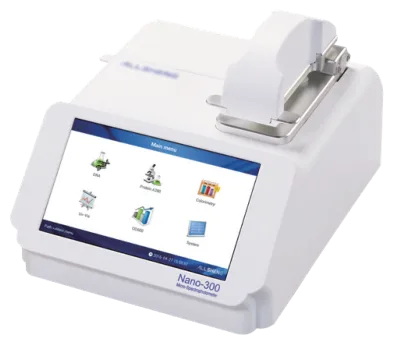
Photometer Nano-400A, measurement volume 1.0 - 2.0 µl
item number: 41047
Wavelengths: 260 nm, 280 nm, measurement within 6 seconds
List price € 4.000,00

Photometers are essential instruments for quantitative analytics in molecular biology, biochemistry and diagnostics. Microphotometers enable concentration determination of DNA, RNA and proteins with sample volumes of only 0.5 to 2 µl. In biotechnology, research and clinical diagnostics laboratories, these instruments are used daily for fast and precise concentration determination.
item number: 41047
List price € 4.000,00
item number: 41042
List price € 7.000,00
item number: 41043
List price € 7.900,00
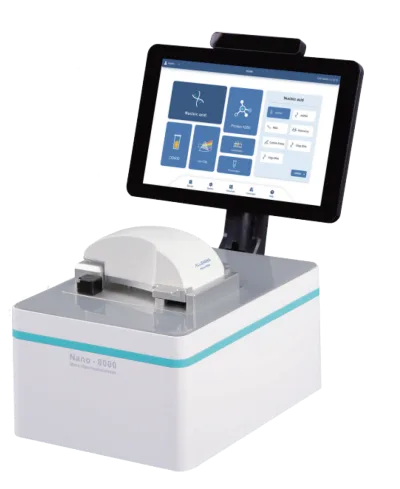
item number: 41048
List price € 8.900,00
item number: 41049
List price € 16.000,00
Microphotometers are specialized photometers for analyzing minimal sample volumes. The instruments offered here work with measuring volumes of 0.5 to 2.0 µl and thus enable concentration determination of valuable samples without significant material consumption. The measurement technology is based on UV/VIS spectrophotometry, in which the extinction at defined wavelengths is recorded.
For nucleic acid determination, wavelengths at 260 nm and 280 nm are particularly relevant: DNA and RNA show an absorption maximum at 260 nm, while proteins are detected at 280 nm. The ratio of these values enables purity assessment of the sample. The photometers offered cover wavelength ranges from 190 to 1100 nm and are therefore also suitable for extended applications.
The instrument selection includes microphotometers with different performance characteristics. The Photometer Nano-400A is fixed to wavelengths 260 nm and 280 nm and enables measurements within 6 seconds – a solution for routine determinations of nucleic acids. The measuring volume is 1.0 to 2.0 µl.
For a broader application range, models with tunable wavelength range from 200 to 800 nm are available, such as the Nano-300 and Nano-500, both with measuring times of 5 seconds and sample volumes of 0.5 to 2.0 µl. The Nano-500 additionally features a fluorescence option (blue), which enables extended detection methods.
The Photometer Nano-1000 covers the extended spectral range from 190 to 1100 nm and thus also permits NIR applications. Measurement takes 8 seconds. For higher sample throughput, the Nano-8000 is designed: It measures up to 8 samples in parallel in the range 190–1100 nm, the measurement time is 20 seconds for all samples.
Photometers and microphotometers are used in numerous areas: In molecular biology for concentration determination of plasmid DNA, genomic DNA or RNA after extraction, in protein analytics for quantification of purified or recombinant proteins, in cell culture for monitoring nucleic acid or protein yields, and in clinical diagnostics for sample preparation for PCR or sequencing.
The small sample volume required by microphotometers makes them particularly valuable for applications with limited sample material, such as biopsies, single-cell analyses or precious expression products. The fast measurement time of 5 to 20 seconds supports efficient workflows in research and quality control.
When selecting a photometer, several factors play a role. The wavelength range defines which substances can be analyzed: Instruments with fixed wavelengths (260/280 nm) are sufficient for standard nucleic acid determinations, tunable instruments (190–1100 nm) additionally allow measurement of enzymes, dyes or other analytes.
The measuring volume is crucial for sample economy: 0.5 µl enables analysis of even the smallest quantities, while 2.0 µl improves the detection limit for less concentrated samples. The measurement time influences throughput, particularly for routine measurements. Instruments with multiple sample function such as the Nano-8000 significantly increase efficiency with large sample volumes.
Additional functions such as fluorescence measurement extend application possibilities to fluorophore-labeled nucleic acids or proteins. The choice depends on typical sample volume, substance spectrum and requirements for speed and automation.
The following answers provide guidance in selecting and using photometers and microphotometers in the laboratory.
Photometers are used for quantitative determination of substances by means of light absorption. Microphotometers are specialized for minimal sample volumes and are mainly used for concentration determination of DNA, RNA and proteins in molecular biology, biotechnology and diagnostics. Typical applications include quality control after nucleic acid extraction, protein quantification or purity determination of samples before PCR or sequencing.
For standard nucleic acid determinations, an instrument with fixed wavelengths at 260 and 280 nm, such as the Nano-400A, is sufficient. If a broader substance spectrum is to be analyzed, instruments with tunable range (e.g. 190–1100 nm) such as Nano-300 or Nano-1000 are advisable. For high sample throughput, a multiple sample system such as the Nano-8000 is recommended. If fluorescence measurements are required, the Nano-500 with fluorescence option is suitable.
DNA and RNA absorb maximally at 260 nm, proteins at 280 nm. The 260/280 nm ratio provides information about nucleic acid purity: values around 1.8 indicate pure DNA, values around 2.0 indicate pure RNA. For extended analyses (e.g. phenol contamination), measurements at 230 nm are useful. Microphotometers with variable wavelength range enable comprehensive purity assessments and quantification of additional analytes.
The Nano models differ in wavelength range, measurement time and sample number. The Nano-400A measures at fixed 260/280 nm in 6 seconds. Nano-300 and Nano-500 cover 200–800 nm (measurement time 5 seconds), with Nano-500 additionally offering fluorescence (blue). Nano-1000 offers 190–1100 nm (8 seconds). The Nano-8000 measures 8 samples in parallel in the range 190–1100 nm in 20 seconds and is suitable for high throughput.
For microphotometers, cleaning agents and lint-free cloths for maintaining the measuring surface are important, as even the smallest contamination affects accuracy. Depending on the model, special cuvettes or holders for alternative sample formats (e.g. micro-cuvettes) may be required. Software updates or PC connectivity for data archiving and evaluation support documentation, particularly in GMP or GLP environments.
Quotations for the listed photometers and microphotometers can be requested via the product page. The desired models, required wavelength ranges, typical sample throughput and any additional functions (e.g. fluorescence, multiple samples) should be specified. Professional consultation supports selection of the appropriate instrument for the respective laboratory requirements.
Before the first measurement, the microphotometer should be calibrated according to manufacturer specifications. The measuring surface must be clean and free of residues. Samples should be pipetted bubble-free and completely removed after measurement. For instruments with variable wavelength range, correct wavelength setting must be ensured. Regular checks with standards (e.g. DNA solutions of known concentration) ensure measurement accuracy over time.