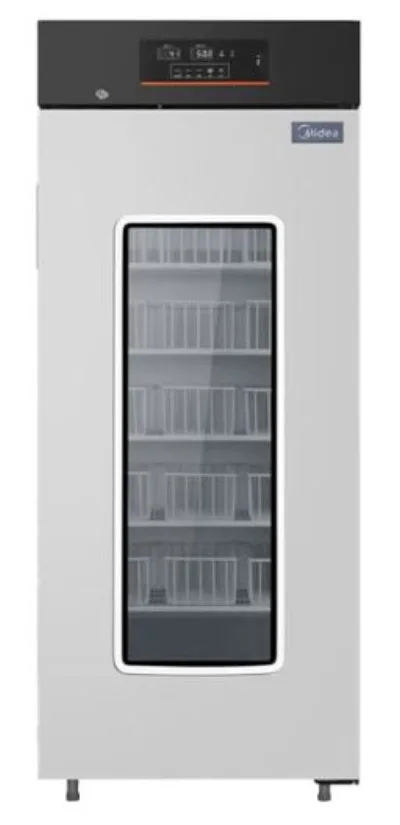
Blutbeutelkühlschrank MIDEA MXY-206, 206 l Volumen, DIN 13277 konform
item number: 41039
Kapazität 150 Blutbeutel 450 ml
List price € 4.950,00

Blood bank refrigerators are used for standards-compliant storage of blood units and blood products in transfusion facilities, blood donation services, hospitals and medical laboratories. The devices designed to DIN 13277 ensure precise temperature control and documentable storage conditions. The range includes capacities from 206 to 1306 litres for different throughput volumes.
item number: 41039
List price € 4.950,00
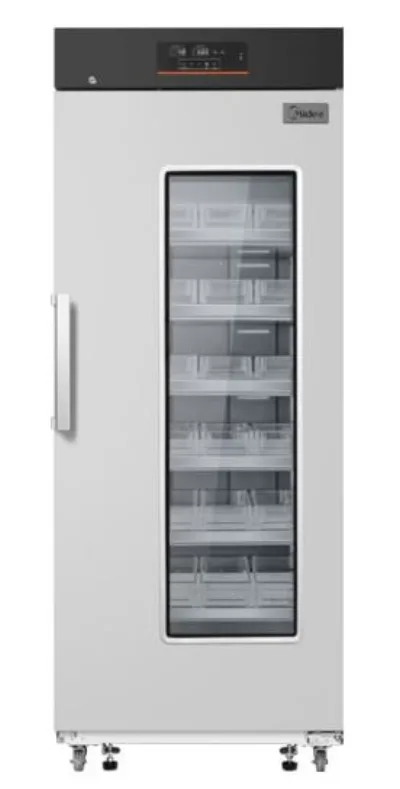
item number: 40956
List price € 7.950,00
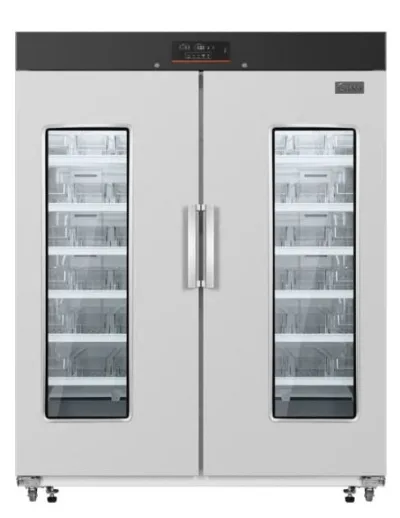
item number: 41040
List price € 9.950,00
Blood bank refrigerators are specialised refrigeration units for the storage of blood bags and other temperature-sensitive blood products. They are used in transfusion medicine, blood donation centres, hospitals, pharmacies with blood depots and diagnostic laboratories. The devices are designed to DIN 13277 to meet the prescribed storage conditions for whole blood and red blood cell concentrates. The available range comprises three volume classes: 206 litres, 558 litres and 1306 litres, offering capacities from 150 to 672 blood bags à 450 ml.
The standard DIN 13277 defines requirements for refrigerators for the storage of blood and blood components. It specifies temperature range, temperature homogeneity, alarm functions and documentation obligations. Blood bank refrigerators complying with this standard ensure uniform cooling throughout the interior to safeguard the quality of blood products during storage. For transfusion medicine facilities and blood donation services, compliance with this standard is a fundamental prerequisite for safe and regulation-compliant operation.
Three blood bank refrigerators by MIDEA are available in the range. The model MIDEA MXY-206 offers 206 litres of usable volume and holds up to 150 blood bags à 450 ml. The model MIDEA MXY-558 with 558 litres accommodates up to 336 blood bags. The largest model, MIDEA MXY-1306, features 1306 litres of volume and a capacity of 672 blood bags. The selection depends on daily throughput, storage duration and the number of blood products stored simultaneously.
Blood bank refrigerators are required wherever blood units are stored, prepared or dispensed. This includes blood banks, transfusion centres, operating theatres with their own depot, emergency departments and intensive care units. Pharmaceutical facilities with blood depots, hospital pharmacies and diagnostic laboratories also use these devices. Standards-compliant storage ensures the quality of blood products and protects against losses due to temperature fluctuations or exceeding permissible limits.
When selecting a blood bank refrigerator, several factors are relevant. The required usable volume results from the average and maximum number of blood bags stored. Conformity with DIN 13277 is mandatory for regulated use. Further criteria include alarm functions, documentation capabilities, energy efficiency, storage accessibility as well as space availability and installation dimensions. For facilities with growing requirements, forward-looking dimensioning is recommended.
The following answers provide guidance on typical questions regarding the selection and use of blood bank refrigerators in transfusion medicine and clinical practice.
Blood bank refrigerators are used for standards-compliant storage of blood units, red blood cell concentrates and other blood products in blood donation services, transfusion centres, hospitals, emergency departments and pharmacies with blood depots. They ensure precise temperature control and documentation in accordance with DIN 13277.
The model MXY-206 with 206 litres and 150 blood bags is suitable for smaller depots or wards. The model MXY-558 with 558 litres and 336 blood bags is designed for medium-sized facilities or departments. The model MXY-1306 with 1306 litres and 672 blood bags is intended for central blood banks or large transfusion centres with high throughput.
DIN 13277 defines requirements for refrigerators for the storage of blood and blood components. It regulates temperature range, temperature homogeneity in the interior, alarm functions in case of deviations as well as requirements for documentation and monitoring. Compliance with this standard is mandatory for use in transfusion medicine and blood donation services.
The three available models differ in usable volume and capacity. The MXY-206 holds 150 blood bags, the MXY-558 up to 336 and the MXY-1306 up to 672 blood bags à 450 ml. All models comply with DIN 13277 and are manufactured by MIDEA. The choice depends on storage volume, space conditions and expected throughput.
Blood bank refrigerators to DIN 13277 require continuous temperature monitoring, alarms when limit values are exceeded and complete documentation. Many devices offer integrated data loggers, interfaces for external monitoring systems and alarm notifications. Documentation must be verifiable and audit-proof to meet regulatory requirements.
Enquiries for blood bank refrigerators can be submitted via the respective product pages. Information on capacity requirements, site of use, required certifications and desired documentation functions should be provided. Professional consultation helps in selecting the appropriate model and clarifies questions regarding installation, validation and qualification.
Blood bank refrigerators must be professionally installed, connected to a stable power supply and validated before commissioning. Validation includes temperature mapping, verification of alarm functions and documentation of performance data. For use in regulated areas, qualification in accordance with GMP requirements or comparable standards is required. Regular maintenance and recalibration ensure continued standards-compliant operation.