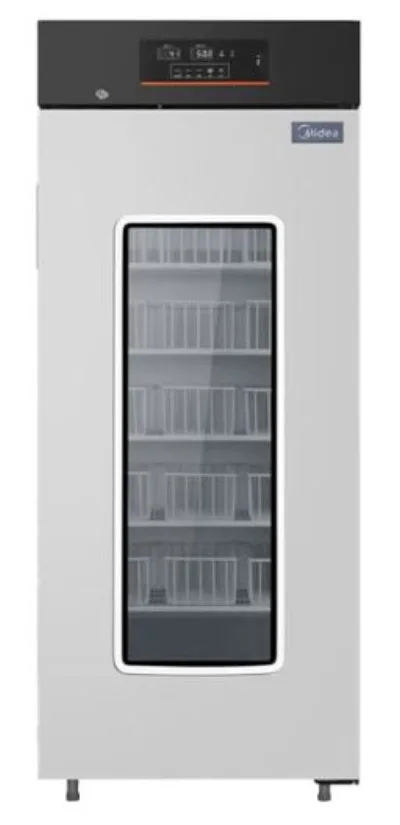
Blutbeutelkühlschrank MIDEA MXY-206, 206 l Volumen, DIN 13277 konform
item number: 41039
Kapazität 150 Blutbeutel 450 ml
List price € 4.950,00

Blood bank refrigerators according to DIN 13277 ensure the safe storage of blood reserves and blood products under controlled temperature conditions. They are used in hospitals, blood banks, transfusion centres and laboratories where compliant storage of whole blood, erythrocyte concentrates and thrombocyte concentrates is required. The models offered by MIDEA include volumes of 206, 558 and 1306 litres with capacities for 150 to 672 blood bags à 450 ml.
item number: 41039
List price € 4.950,00
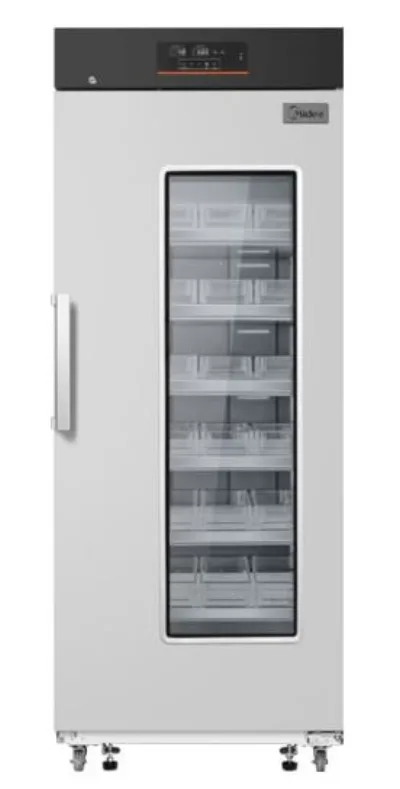
item number: 40956
List price € 7.950,00
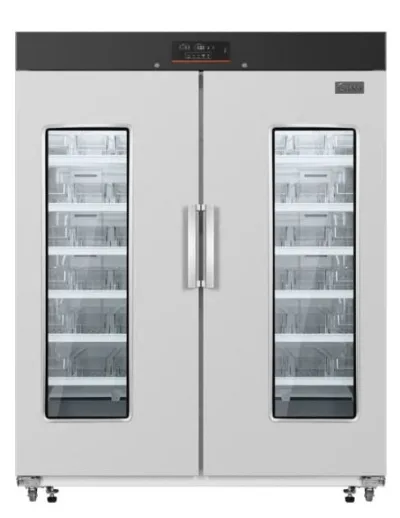
item number: 41040
List price € 9.950,00
Blood bank refrigerators are specialised refrigeration units for the storage of blood reserves and blood products in medical and laboratory diagnostic facilities. The standard DIN 13277 defines requirements for refrigeration equipment for the storage of blood reserves and ensures that temperature stability, homogeneity and monitoring comply with medical standards. All models offered here are DIN 13277 compliant and are suitable for blood banks, transfusion medicine, hospitals and clinical laboratories.
The range includes three blood bank refrigerators from MIDEA with different volumes. The MIDEA MXY-206 offers 206 litres of usable capacity and holds 150 blood bags à 450 ml. The medium model MIDEA MXY-558 has 558 litres and accommodates 336 blood bags à 450 ml. For larger facilities, the MIDEA MXY-1306 with 1306 litres volume is available, which can store up to 672 blood bags à 450 ml. All units are DIN 13277 compliant.
Blood bank refrigerators are used wherever blood products must be safely and compliantly stored. These include blood donation services, transfusion centres, hospital blood banks, emergency departments and operating theatre areas. These units are also used in larger laboratories with haematological or immunohaematological examinations. Compliance with DIN 13277 is a prerequisite for approval and operation in transfusion medicine.
When selecting a blood bank refrigerator, capacity, standard compliance and spatial conditions are decisive. The number of blood bags to be stored determines the required volume: 206 litres for smaller units, 558 litres for medium requirements and 1306 litres for central blood banks. Compliance with DIN 13277 ensures adherence to medical requirements. Further criteria include temperature monitoring, alarm functions, documentation capabilities and integration into existing validation systems.
The DIN 13277 standard specifies that refrigeration equipment for blood storage must provide homogeneous temperature distribution, precise control and reliable alarming in case of deviations. It also requires regular calibration, maintenance and documentation. Blood bank refrigerators according to this standard are designed for the specific requirements of transfusion medicine and thus differ from general laboratory refrigerators. DIN 13277 compliance is mandatory in Germany for the storage of blood products.
The following section answers the most important questions about the selection, standard compliance and operation of blood bank refrigerators according to DIN 13277.
Blood bank refrigerators serve the safe and compliant storage of blood reserves, erythrocyte concentrates, thrombocyte concentrates and other blood products. They are used in blood banks, transfusion centres, hospitals, emergency departments and haematological laboratories where compliance with DIN 13277 is required for approval.
The required capacity depends on the number and type of blood products stored. The MIDEA MXY-206 with 206 litres holds 150 blood bags à 450 ml and is suitable for smaller wards or laboratories. The MIDEA MXY-558 with 558 litres provides space for 336 blood bags and is suitable for medium-sized facilities. For central blood banks and large clinics, the MIDEA MXY-1306 with 1306 litres and 672 blood bags is available.
DIN 13277 defines requirements for refrigeration equipment for the storage of blood reserves. It specifies precise and homogeneous temperature distribution, reliable monitoring and alarm functions as well as regular calibration and maintenance. All blood bank refrigerators from MIDEA offered here are DIN 13277 compliant and meet these medical requirements for transfusion medicine.
The three models differ in volume and capacity. The MXY-206 offers 206 litres for 150 blood bags, the MXY-558 comprises 558 litres for 336 blood bags and the MXY-1306 provides 1306 litres for 672 blood bags. All are DIN 13277 compliant and from MIDEA. The choice depends on storage requirements and the size of the facility.
For compliant operation, temperature monitoring systems with data loggers, alarm systems for temperature deviations, external temperature sensors and documentation software are advisable. Accessories such as special insertion systems for blood bags, shelves and dividing elements increase clarity. Integration into central monitoring systems enables complete traceability in accordance with DIN 13277.
Enquiries about blood bank refrigerators can be made via the respective product pages or directly with the supplier. For needs-based advice, information on capacity, place of use, standard requirements and any validation requirements is helpful. All models offered are DIN 13277 compliant and can be configured for different facility sizes.
Commissioning takes place after installation and verification of temperature homogeneity throughout the interior. For medical use, qualification according to DIN 13277 is required, which includes calibration, mapping and documentation. Regular maintenance, verification of alarms and continuous temperature recording are part of the validation and a prerequisite for compliant use in blood banks and transfusion centres.