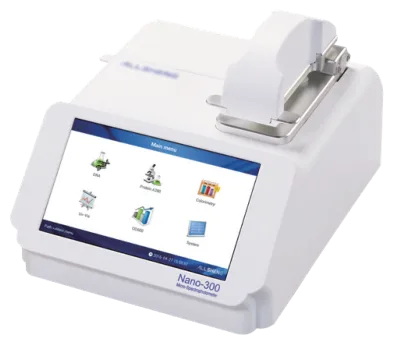
Photometer Nano-400A, measurement volume 1.0 - 2.0 µl
item number: 41047
Wavelengths: 260 nm, 280 nm, measurement within 6 seconds
List price € 4.000,00

Microphotometers enable precise spectrophotometric analysis of minimal sample volumes between 0.5 and 2 µl. They are used in research laboratories, biotechnology, pharmaceuticals and diagnostics for concentration determination of nucleic acids and proteins. The instruments operate with wavelengths in the UV and VIS range from 190 to 1100 nm and deliver measurement results within seconds.
item number: 41047
List price € 4.000,00
item number: 41042
List price € 7.000,00
item number: 41043
List price € 7.900,00
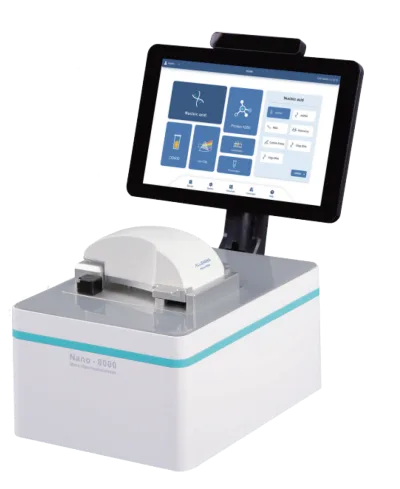
item number: 41048
List price € 8.900,00
item number: 41049
List price € 16.000,00
Microphotometers utilize the absorption of light at defined wavelengths to determine the concentration of biomolecules in minimal sample volumes. Typical applications include quantification of DNA at 260 nm, RNA analyses and protein measurements at 280 nm. The capability to work with volumes from 0.5 µl conserves valuable samples and minimizes consumption of expensive reagents. The instruments are suitable for molecular biology laboratories, research institutions, pharmaceutical companies and diagnostic laboratories.
The available microphotometers cover different spectral ranges. While simpler models operate with fixed wavelengths at 260 nm and 280 nm, extended variants offer a continuous wavelength range from 200 to 800 nm or 190 to 1100 nm. The measurement speed varies depending on the model between 5 and 20 seconds per measurement. Faster measurement times of 5 to 8 seconds enable high sample throughput, while instruments with 8-sample capacity measure up to eight samples in one run, thus increasing efficiency in routine operations.
A central feature of microphotometers is the minimal sample volume. Most instruments require between 0.5 and 2.0 µl, enabling reliable analysis of even the smallest sample quantities. This characteristic is particularly valuable for limited or precious samples, such as those encountered in basic research, clinical studies or when working with rare biomaterials. Handling is typically performed by pipetting directly onto the measurement surface, without requiring cuvettes.
When selecting a microphotometer, several parameters are decisive. The wavelength range determines which substances can be measured: instruments with 190 to 1100 nm are suitable for a broad spectrum of analyses, while models with fixed wavelengths are sufficient for standardized nucleic acid measurements. The measurement volume should match the available sample material, with volumes from 0.5 µl offering maximum flexibility. The measurement time is relevant for high sample throughput, and instruments with multiple sample capacity such as the 8-sample system significantly increase efficiency.
The product range includes microphotometers with different technical specifications. The Nano-400A operates with fixed wavelengths at 260 nm and 280 nm and requires 1.0 to 2.0 µl sample volume with a measurement time of 6 seconds. The Nano-300 and Nano-500 models cover 200 to 800 nm, operate with 0.5 to 2.0 µl and measure within 5 seconds; the Nano-500 additionally features fluorescence detection in the blue range. The Nano-1000 extends the wavelength range to 190 to 1100 nm with 8 seconds measurement time, while the Nano-8000 analyzes eight samples in parallel in 20 seconds.
The following section addresses key questions regarding the selection and use of microphotometers.
Microphotometers serve for precise concentration determination of nucleic acids (DNA, RNA) and proteins in minimal sample volumes. They are employed in molecular biology, biotechnology, pharmaceuticals, diagnostics and research to conserve valuable samples and obtain rapid, reliable measurement results. Typical applications include purity testing, quantifications prior to PCR assays or quality control of extractions.
For standardized nucleic acid measurements, instruments with fixed wavelengths at 260 nm and 280 nm are sufficient. If a broader spectrum of substances is to be analyzed, models with continuous wavelength range from 200 to 800 nm or 190 to 1100 nm are recommended. For high sample throughput, instruments with 8-sample capacity offer significant time advantages. The required sample volume should match the available material, with instruments from 0.5 µl offering maximum flexibility.
The wavelength 260 nm is used for quantification of nucleic acids (DNA and RNA), as these exhibit their absorption maximum there. The wavelength 280 nm serves for protein determination. The ratio of absorbances at 260 nm and 280 nm also provides information about the purity of nucleic acid preparations: pure DNA shows a ratio of approximately 1.8, pure RNA of approximately 2.0. Deviations indicate contamination.
The models differ in wavelength range, measurement volume, measurement speed and sample capacity. Simpler variants operate with fixed wavelengths and require 1.0 to 2.0 µl, while more flexible instruments offer 0.5 to 2.0 µl and continuous spectra from 190 to 1100 nm. Some models feature fluorescence detection. Instruments with 8-sample capacity enable parallel measurements and significantly increase throughput, but require somewhat longer measurement times per run.
For routine use, precise microliter pipettes are essential to apply reproducible sample volumes. Cleaning materials for the measurement surface, lint-free wipes and suitable cleaning solutions ensure consistent measurement quality. Depending on the instrument, calibration and reference standards may be required for regular verification of measurement accuracy. For documentation and data evaluation, connection to laboratory information systems or PC software is often helpful.
For an individual quotation or technical consultation on selecting the appropriate microphotometer, interested parties can contact the supplier directly. The desired wavelength ranges, available sample volume, expected sample throughput as well as special requirements such as fluorescence detection or multiple sample capacity should be specified to receive a tailored recommendation.
Calibration of microphotometers is typically performed using certified reference standards with known absorption values. Many instruments offer internal calibration routines that should be performed regularly. For use in regulated environments such as GMP laboratories, formal validation may be required, including performance qualification (PQ) and verification of linearity, precision and accuracy. Documented maintenance and calibration protocols ensure traceability and measurement quality.