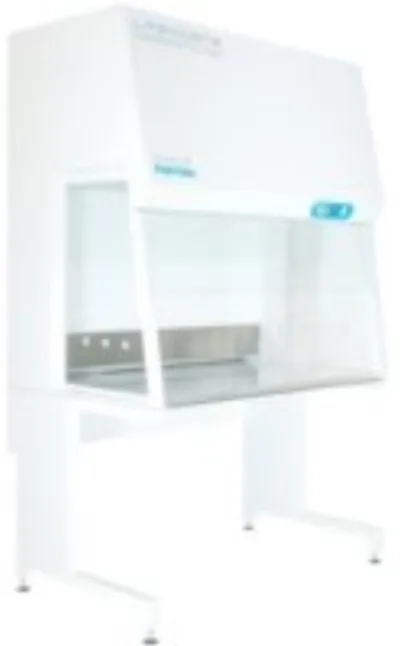
Clean Room Workbench Scanlaf Type Fortuna Clean Bench 1200
item number: 18036
Vertical Flow
Price on request

Product protection fume hoods are designed to protect sensitive samples, materials, and products from contamination by particles and microorganisms in the ambient air. They are used in laboratories, pharmaceuticals, biotechnology, and quality control where sterile or low-particle working conditions are required. Unlike safety cabinets, the focus of product protection fume hoods is on protecting the work material, not primarily on user protection.
item number: 18036
Price on request
Product protection fume hoods, often referred to as clean benches, create a low-particle work zone through HEPA filtration and a directed airflow. The filtered air flows vertically (vertical flow) or horizontally across the work surface, thereby protecting the work material from contamination. Typical applications include cell culture, media preparation, electronic manufacturing, pharmaceutical quality control, as well as microscopy and sample preparation, where freedom from contamination is critical.
The airflow in product protection fume hoods is generally a vertical or horizontal laminar airflow. In the vertical flow design, filtered air flows from top to bottom across the work surface, allowing for uniform displacement of particles. Horizontal flow variants direct air from the rear wall to the front opening. Since there is no retention of contaminated air as with safety cabinets, product protection fume hoods are suitable exclusively for work involving non-hazardous or non-toxic substances.
When selecting a product protection fume hood, the required working width, the type of airflow, and the purity requirements of the application are decisive. Also important are the filter class (usually HEPA H14), the air velocity in the work area, and the design of the work surface. For GMP-regulated areas, the possibility of validation, documentation of air purity, and regular filter changes should be considered. Integration into existing laboratory environments and potential requirements for negative pressure maintenance or extraction also play a role.
Product protection fume hoods protect only the work material, whereas Class 2 safety cabinets according to EN 12469 protect the user, the product, and the environment. Safety cabinets feature extracted front apertures and HEPA-filtered exhaust air, which ensure biosafety. Product protection fume hoods, by contrast, have open front areas and are not suitable for handling infectious material, hazardous substances, or toxic substances. The choice between the two equipment classes depends on the protection goal of the respective application.
The following answers address key questions regarding the selection, use, and operation of product protection fume hoods.
Product protection fume hoods are used wherever sensitive samples, materials, or products must be protected from contamination by particles and microorganisms. Typical applications include cell culture work, sterile media preparation, pharmaceutical quality control, microbiological sample preparation, electronics manufacturing, and optical assembly. They create a low-particle zone but do not protect the user or the environment.
The choice of working width depends on the space required for equipment, materials, and work processes. Common widths range between 90 and 180 cm. For smaller individual tasks or confined laboratory environments, compact models around 90 to 120 cm are sufficient, while extensive experimental setups or parallel work on multiple samples require wider versions from 150 cm. Spatial integration and accessibility should also be considered.
Vertical flow refers to the vertical airflow from top to bottom. Filtered air is passed through HEPA filters and flows laminarly across the work surface, displacing particles downwards. This design allows for uniform flow through the work area and minimizes turbulence. Vertical flow is particularly common as it allows good accessibility to the work surface and is suitable for many sterile applications.
Product protection fume hoods protect only the work material from contamination, not the user or the environment. Class 2 safety cabinets according to EN 12469 offer additional personal protection through extracted front apertures and filtered exhaust air. They are mandatory for work with infectious material, hazardous substances, or biological agents. The choice depends on the hazard potential of the materials: for harmless materials, a product protection fume hood is sufficient; for biological or toxic substances, a safety cabinet is required.
Useful accessories include UV lamps for surface decontamination, height-adjustable work surfaces, side acrylic panels to reduce air turbulence, as well as power strips and gas connections for equipment in the work area. For monitoring, particle counters, air velocity meters, and differential pressure gauges are helpful. Regular filter changes and validation protocols are indispensable in GMP environments. The specific equipment depends on the respective application and regulatory requirements.
For professional advice on product protection fume hoods and an individual quote, please contact a laboratory equipment specialist or a dedicated supplier. A detailed description of your application, planned workflows, required working width, and any standards or GMP requirements will facilitate the precise selection. Many suppliers also provide support with planning validations and integration into existing laboratory infrastructure.
Commissioning includes installation at a vibration-free, level location, connection to the power supply, and a functional check of the fan and airflow. Before initial use, the air velocity should be measured, filter integrity checked, and particle concentration in the work area documented. In regulated environments, initial qualification (IQ/OQ) is required. Regular maintenance, filter changes, and recurring validations ensure the permanent compliance with purity requirements.