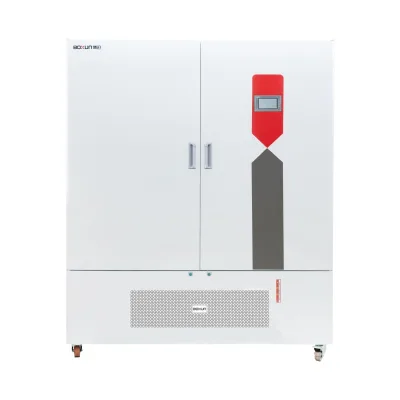
Drosophila Incubator 800 l Volume with Four Horizontal Light Fields, Demonstration Unit
item number: 39477
Temperature range 0°C - 70°C, LED lighting with daylight spectrum
In stock
€ 29.800,00
Promotional Price € 9.500,00

Refrigerated incubators are used for the precise temperature control of samples in microbiology, pharmaceuticals, and research. These units enable stable incubation conditions both above and below ambient temperature. Specialist users utilise specific designs such as Drosophila incubators for complex test series with controlled lighting.
item number: 39477
€ 29.800,00
Promotional Price € 9.500,00
A refrigerated incubator is an essential instrument for laboratories that need to store or incubate samples at constant temperatures, often below room temperature. The integration of cooling systems covers a wide temperature range, which in specialised models extends from 0°C to 70°C. This allows for both incubation and cool storage in a single unit.
Within the category of refrigerated incubators, Drosophila incubators hold a special position. These units are specifically tailored to the needs of insect breeding and research. A key feature is the integration of daylight spectrum LED light, which is often distributed across several horizontal light panels to simulate natural day-night cycles.
When selecting a suitable unit, the volume is a decisive criterion. Large-capacity units with up to 800 litres of capacity offer sufficient space for extensive test series. The technical equipment includes precise control systems that ensure homogeneous temperature distribution in the interior, which is essential for reproducible results in diagnostics and biotechnology.
Here you will find answers to frequently asked questions regarding the selection and operation of refrigerated incubators and specialised breeding units.
Refrigerated incubators are used for the incubation of microbiological cultures, for stability tests in the pharmaceutical industry, and for the cultivation of organisms at temperatures below room temperature.
In addition to temperature control, these units feature integrated lighting systems with a daylight spectrum to replicate the natural living conditions of fruit flies for research purposes.
Depending on the model and technical equipment, these units cover a range from 0°C up to 70°C, allowing for flexible use for both cooling and heating.
The volume, for example 800 litres, must be matched to the sample quantity. Larger capacities allow the use of horizontal light panels for the uniform illumination of many samples simultaneously.
Modern units use LED light panels that emit a specific daylight spectrum and are often controlled via timers for defined light-dark phases.
For the selection between standard refrigerated incubators and specialised Drosophila models, professional advice can be requested to coordinate technical parameters such as light intensity and volume.
The functionality of the horizontal light panels should be checked regularly to ensure constant light exposure of the samples across the entire temperature range.