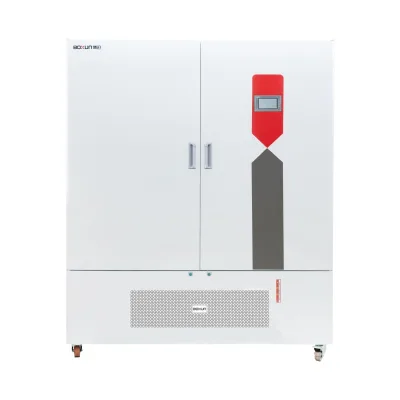
Drosophila Incubator 800 l Volume with Four Horizontal Light Fields, Demonstration Unit
item number: 39477
Temperature range 0°C - 70°C, LED lighting with daylight spectrum
In stock
€ 29.800,00
Promotional Price € 9.500,00

Drosophila incubators are specialised refrigerated incubators designed for the breeding and maintenance of fruit flies in biological research and genetics. These units provide precisely controlled conditions regarding temperature and lighting for users in biotechnology, science, and entomology.
item number: 39477
€ 29.800,00
Promotional Price € 9.500,00
A Drosophila incubator enables the precise control of thermal conditions essential for the development of insect populations. With a temperature range of 0°C to 70°C, these units cover standard breeding temperatures while also allowing for thermal stress tests or diapause studies under controlled laboratory conditions.
The integration of daylight spectrum LED lighting is a key feature of this equipment class. Four horizontal light panels ensure uniform light distribution throughout the interior. This is crucial for simulating natural day-night cycles and achieving consistent growth conditions on all levels of the incubator.
Models with a volume of 800 litres offer sufficient space for extensive sample quantities and breeding vessels in large research facilities. These refrigerated incubators are primarily used in genetics, developmental biology, and behavioural research. The robust construction supports the continuous operation required for long-term research study series.
Here you will find answers to technical and application-related questions regarding the cultivation of Drosophila in specialised incubators.
They are used for the controlled breeding and maintenance of fruit flies under specific light and temperature conditions in genetics and biology.
The required volume depends on the sample volume; units with 800 litres capacity are particularly suitable for facilities with high throughput.
Specialised models cover a wide range from 0°C to 70°C to enable various climatic scenarios and experimental setups.
Drosophila models feature specialised light control, such as horizontal light panels with daylight spectrum, which are tailored to the biological needs of the insects.
This light spectrum simulates natural conditions for insect breeding, while LED technology minimises heat input into the interior.
Professional advice on configurations, volume classes, and lighting options can be requested via a specific enquiry for the respective equipment class.
It ensures that samples on different shelf levels receive the same light intensity, which improves the reproducibility of research results.