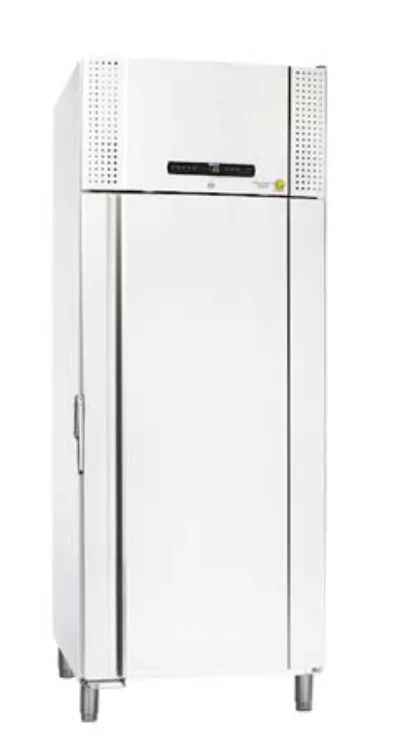
GRAM -35°C Forced-Air Ultra-Low Temperature Freezer BioPlus EF600-W (600 Liters), White
item number: 15377
Interior stainless steel, unit mounted on 4 casters, variable interior configuration
List price € 7.210,00

Our laboratory deep freezers provide reliable storage for sensitive samples at temperatures of -30°C and -35°C. These units are designed to ensure precise temperature control and secure conditions for your laboratory requirements.
item number: 15377
List price € 7.210,00
item number: 15379
List price € 7.360,00
Laboratory freezers with temperatures down to -30°C and -35°C are used in research facilities, diagnostic laboratories and pharmaceutical operations for storing temperature-sensitive samples. This equipment class enables the safe storage of biological materials, reagents and reference samples that require constant deep-freezing below standard freezing temperature. The selection of the appropriate unit depends on storage volume, space conditions and the specific requirements of the laboratory.
The offered GRAM forced-air freezers of the BioPlus series reach temperatures down to -35°C and are available in two volume variants: the EF600-W with 600 liters and the EF660-W with 660 liters usable capacity. Both models feature a stainless steel interior and have a white exterior. The units stand on 4 casters, which enables flexible positioning in the laboratory.
Both GRAM models offer variable interior equipment that can be adapted to different sample containers and storage requirements. This flexibility is particularly important in laboratories with changing project requirements or different sample formats. The stainless steel interior ensures a hygienic surface that is easy to clean.
The forced-air technology of the offered freezers ensures homogeneous temperature distribution throughout the entire interior. This is important for uniform cooling of all stored samples, regardless of their position in the cabinet. Forced-air units are characterized by faster temperature recovery after door openings, which can be relevant with frequent access to sample material.
When selecting a laboratory freezer in the -30°C to -35°C range, in addition to the required storage volume, the floor space, energy efficiency and requirements for documentation and monitoring should also be considered. Mobility through casters can be advantageous in laboratories with changing space requirements or during cleaning work. The material choice of the interior influences hygiene and cleaning effort.
Freezers of this temperature class are used in microbiological research, clinical diagnostics, biotechnology and quality control. They are suitable for storing enzymes, antibodies, cell lines and other biological materials that remain stable at temperatures between -30°C and -35°C. Such units are also used for sample storage in food analysis and environmental analysis.
Below we answer the most important questions about the selection and use of laboratory freezers in this temperature range.
This temperature class is used for storing enzymes, antibodies, microbiological samples, cell lines and reagents that require constant deep-freezing below -25°C. They are used in research laboratories, diagnostic facilities, biotechnology and pharmaceutical quality control.
The GRAM BioPlus forced-air freezers are available with 600 liters (model EF600-W) and 660 liters (model EF660-W) usable capacity. The choice depends on sample throughput and available floor space in the laboratory.
Forced-air freezers use a fan to circulate cold air in the interior. This leads to uniform temperature distribution and faster temperature recovery after opening the door. This technology is particularly advantageous with frequent access to samples.
Stainless steel is corrosion-resistant, hygienic and easy to clean. In laboratories with high hygiene requirements or when storing sensitive biological samples, a stainless steel interior is advantageous because it does not absorb odors or substances.
The four casters enable flexible positioning and facilitate moving the unit during cleaning work, renovations or maintenance measures. This is particularly practical in laboratories with changing space requirements or when reorganizing work areas.
Variable interior equipment allows the adaptation of shelves, drawers or baskets to different sample containers and storage requirements. This offers flexibility with changing projects or different sample formats in the same laboratory.
For selecting the suitable laboratory freezer, storage volume, sample type, access frequency, space conditions and any documentation requirements should be considered. Professional consultation helps to find the optimally suitable unit for the specific laboratory requirements.