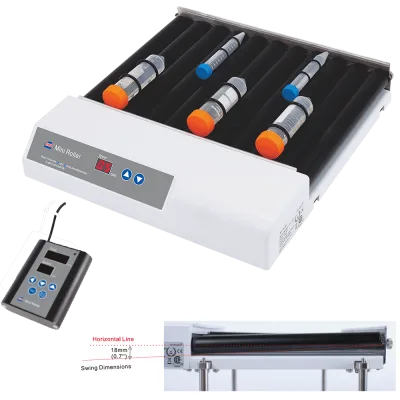
3D Mini Roller Mixer, stackable MR-03U
item number: 40279
11 interchangeable rollers, variable speed adjustable from 0.5 - 80 rpm
List price € 1.236,00

Roller mixers are essential laboratory instruments for the gentle and uniform mixing of samples in closed vessels such as test tubes or sample tubes. They are primarily used in haematology, biotechnology, and clinical diagnostics to reliably prevent the sedimentation of sample components. The range includes compact tube rollers as well as stackable models with precisely adjustable speeds.
item number: 40279
List price € 1.236,00
item number: 15182
List price € 1.141,14
item number: 15186
List price € 1.141,14
item number: 15183
List price € 608,80
item number: 15184
List price € 602,80
item number: 15179
List price € 456,23
In daily laboratory practice, roller mixers ensure homogeneous mixing of blood samples, cell suspensions, or viscous substances. The combination of rotation and a rocking motion ensures that the contents of the vessels remain in constant motion. This device class is specifically designed for reliable use in research laboratories and clinical facilities.
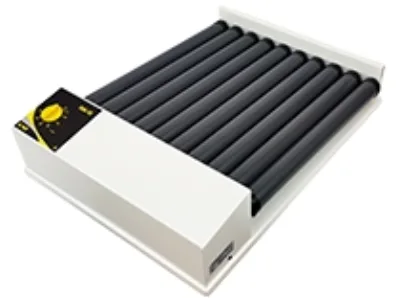
The selection of the appropriate mixer depends primarily on the sample volume and the type of vessel. Available models offer capacities of 5, 10, or 11 rollers. Versions with interchangeable rollers are particularly flexible, allowing for easy cleaning or adaptation to different diameters. For laboratories with limited bench space, stackable 3D mini roller mixers are also available.
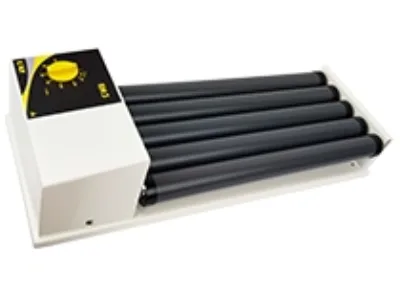
A decisive feature is the variable speed control, which allows for precise adjustment to the respective application. The range extends from very slow 0.5 rpm for highly sensitive samples to 80 rpm for more intensive mixing. Models such as the tube roller RM 10 or RM5 cover various speed ranges to achieve both gentle and powerful mixing processes.
Here you will find answers to technical and application-related questions about our laboratory roller mixers.
Roller mixers are used for the uniform mixing of sample material in closed vessels. They prevent the settling of cells or particles in liquids, which is particularly critical for blood samples prior to analysis in haematology.
The number of rollers determines the capacity. Models with 5 rollers are suitable for smaller sample quantities, while versions with 10 or 11 rollers allow for higher throughput and can accommodate more vessels simultaneously.
Interchangeable rollers significantly facilitate the decontamination and cleaning of the device. Furthermore, they allow the distance between the rollers to be varied in some cases, enabling the secure mixing of larger vessels.
This depends on the viscosity and sensitivity of the sample. Variable ranges of 4-30 rpm are ideal for gentle mixing, while speeds up to 70 or 80 rpm are used for faster homogenisation processes.
Yes, for laboratories with limited space, there are stackable models such as the 3D mini roller mixer MR-03U. These allow capacity to be expanded vertically without requiring additional bench space.
For every model, such as the RM 10 CAT or the RM5 series, you can request an individual quote directly via the button to obtain the appropriate terms for your requirements.
While simple roller mixers only rotate, tube rollers additionally perform a rocking up-and-down motion. This 3D movement ensures even more effective mixing of the sample vessels.