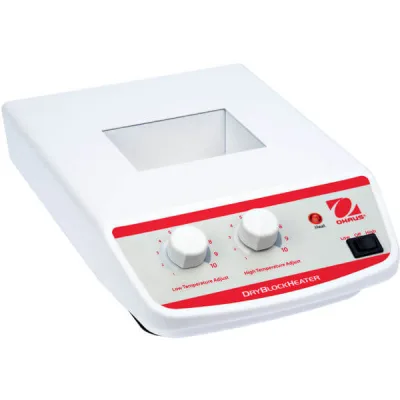
Analog Heating Block HB1AL for 1 Block, Base Unit without Block
item number: 40161
Tool-free block exchange, dual-adjustment knobs with scale
List price € 510,00

Block heaters (heating only) are used in laboratories for the targeted temperature control of samples in reaction vessels when no cooling function is required. These devices are suitable for applications in diagnostics, molecular biology, pharmacology, and chemical analysis. Versions are available for one to four interchangeable blocks, with analogue, digital, or programmable control.
item number: 40161
List price € 510,00
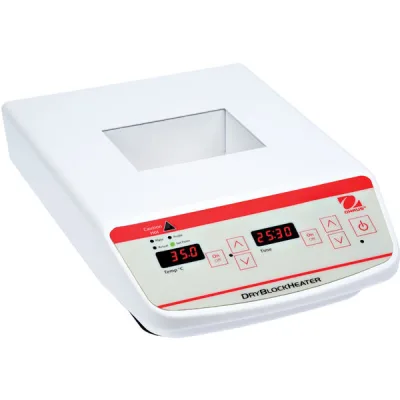
item number: 40160
List price € 755,00
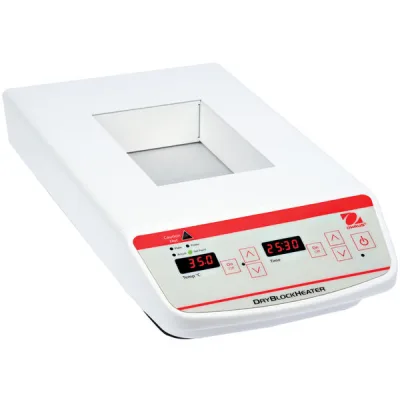
item number: 40158
List price € 965,00
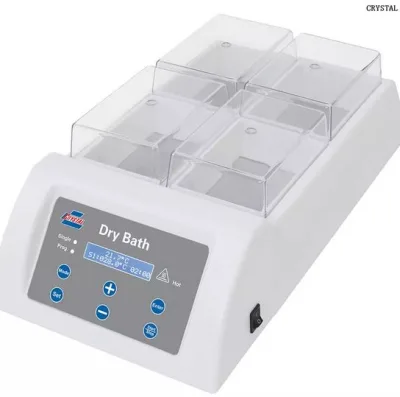
item number: 39973
List price € 940,00
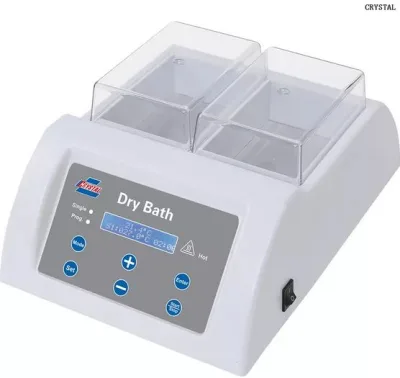
item number: 39972
€ 710,00
Promotional Price € 497,00
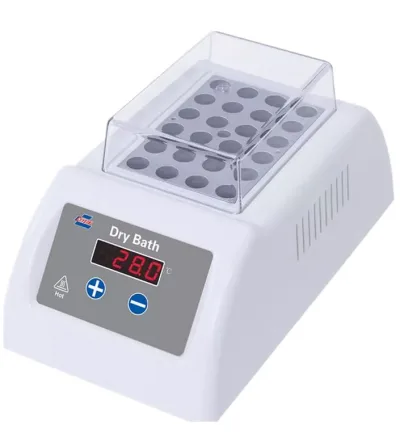
item number: 39970
List price € 400,00
item number: 28580
Price on request
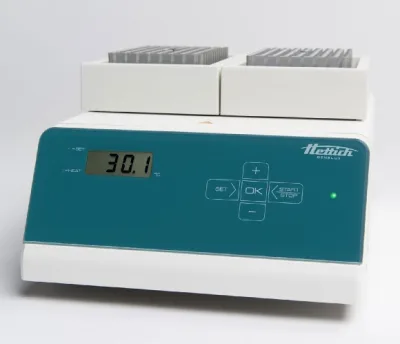
item number: 15712
List price € 1.472,00
Block heaters are used for the precise temperature control of samples in various vessel formats. They work exclusively with a heating function and cover typical laboratory applications where temperatures above room temperature up to 100°C are required. The devices are used in sample preparation, enzymatic reactions, sample digestion, or incubation tasks. The tool-free block change allows for quick adaptation to different vessel sizes.
The range includes analogue heating blocks with mechanical control via adjustment knobs and a scale, digital heating blocks with touchpad operation and an acoustic alarm, as well as programmable block thermostats with advanced functions. Devices are available for one, two, or four blocks. Programmable models feature transparent anti-condensation lids, which are included in the scope of delivery and prevent condensation on the inside of the lid.
The block heaters cover a temperature range from room temperature plus 5°C to 100°C, as seen in compact models for 12 × 1.5 ml reaction vessels. This range is suitable for standard applications such as DNA denaturation, enzyme assays, incubations, or heating reagents. Devices without cooling are designed for applications that do not require temperatures below room temperature.
All featured block heaters allow for block changes without tools. This enables different vessel formats – from micro-reaction vessels and PCR tubes to larger tubes – to be adapted quickly. The flexibility in block changing makes the devices versatile tools in laboratories with changing sample formats and experimental setups.
Different control concepts are available for various requirements. Analogue heating blocks offer simple dual adjustment with a scale, while digital models feature a touchpad and acoustic alarm. Programmable variants allow for the storage of temperature profiles and time-controlled sequences. Simple block heaters with Easy Control do not offer programming and provide standard control.
The block heaters (heating only) category exclusively includes devices without active cooling. They are suitable for applications that do not require temperatures below room temperature. For protocols with cooling steps, temperature-controlled cycles, or precise temperature regulation over the entire range, block heaters with cooling and heating functions are available as a separate device class.
Typical user questions regarding this device class are answered below.
Block heaters without cooling are suitable for all laboratory applications that require defined heating of samples without needing temperatures below room temperature. Typical areas of application include incubations, enzymatic reactions, DNA denaturation, sample preparation in analysis, and the heating of reagents in molecular biology and diagnostics.
For small sample numbers or individual experiments, block heaters for one block are suitable. Models for two blocks allow for parallel approaches with different temperatures or vessel formats. Devices for four blocks offer high flexibility and capacity for routine applications with high throughput or several simultaneous test series.
Programmable block heaters allow for the storage of temperature profiles and time-controlled sequences. They are suitable for standardised protocols where temperature steps and holding times must be maintained reproducibly. Transparent anti-condensation lids, which are included with programmable models, prevent condensation and protect samples from contamination.
Analogue heating blocks use mechanical adjustment knobs with a scale and offer simple, robust operation. Digital models feature touchpad control and an acoustic alarm for more precise temperature control. Programmable devices allow for the saving of temperature profiles and time-controlled sequences, which improves the reproducibility and automation of standard protocols.
Important accessories include interchangeable blocks for different vessel formats, which can be exchanged without tools. Anti-condensation lids, which are included with programmable models, prevent condensation and protect samples. For precise temperature monitoring, external temperature sensors or calibration services may be useful, depending on documentation requirements.
For a quote or advice on block heaters without cooling, you can submit an enquiry via the product page. Information regarding desired vessel formats, sample numbers, temperature range, and control type should be provided. Professional advice helps in selecting the suitable model for the respective area of application.
Temperature accuracy depends on the design and calibration of the device. Digital and programmable block heaters generally offer more precise regulation than analogue models. For GLP or GMP-compliant working environments, regular calibration and documentation of temperature values are required, which are carried out by external service providers or internal quality assurance, depending on the laboratory.