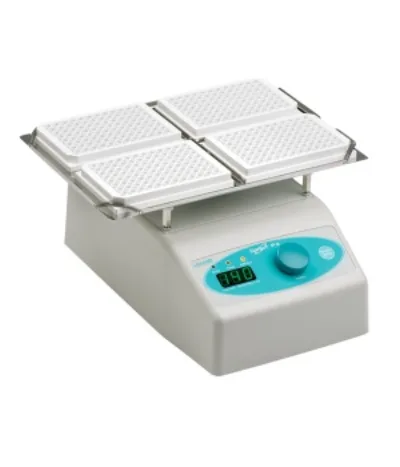
Microtiter Plate Shaker Orbit TM for 4 Plates
item number: 31787
Adjustable speed from 100 to 1,200 rpm
Price on request

Shakers for microtiter plates enable the controlled mixing of samples in standardised multiwell plates for diagnostics and biotechnology. These specialised laboratory shakers are designed for the requirements of small sample volumes in research. The devices ensure a homogeneous distribution of reagents in 96- or 384-well plates.
item number: 31787
Price on request
A microtiter plate shaker is characterised by a small orbital amplitude and high frequencies to effectively move liquids in the narrow wells of microtiter plates. Devices such as the Orbit TM offer a capacity for up to four plates simultaneously, which increases throughput in the laboratory. The speed can be precisely adjusted in the range of 100 to 1,200 rpm.
When selecting a suitable shaker, capacity and speed control are the primary considerations. While compact models save space on the laboratory bench, versions for multiple plates are ideal for serial examinations. Important technical features include stability at high speeds and the exact adjustment of the shaking frequency to avoid sample loss.
Here you will find answers to technical and application-related questions regarding the use of plate shakers in the laboratory.
These shakers are primarily used for mixing reagents in microtiter plates, for example in ELISA tests, enzymatic reactions, or in cell culture preparation.
Depending on the model, such as the Orbit TM, up to four microtiter plates can be securely fixed and shaken at the same time.
For mixing in small wells, speeds of 100 to 1,200 rpm are common to generate sufficient kinetic energy without spilling.
Plate shakers have special holders for multiwell plates and often work with smaller amplitudes at higher frequencies than general orbital shakers.
Useful accessories include specific holders or attachments that guarantee secure fixation of the plates even at a maximum speed of 1,200 rpm.
Professional customers can request an exclusive quote for the desired microtiter plate shakers and corresponding accessories via the product list.
Uniform mixing is achieved through the precise electronic control of the speed and the specific orbital shaking motion.