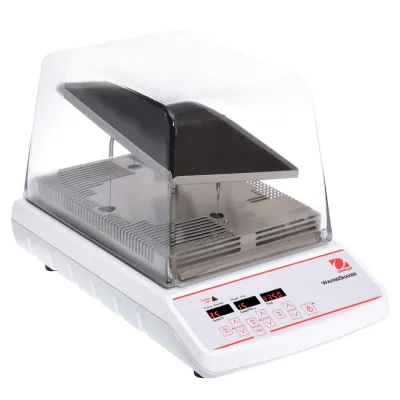
Incubation 3D Shaker ISWV02HDG
item number: 39977
Temperature Range Ambient +5°C – 65°C
List price € 3.725,00

Rocking or tumbling shakers enable gentle mixing of samples in biotechnology and diagnostic laboratories. These devices are frequently used for staining gels or for incubation processes within a temperature range of up to 65 °C. The range includes compact benchtop units as well as variants with multi-tier platforms for higher sample throughput.
item number: 39977
List price € 3.725,00
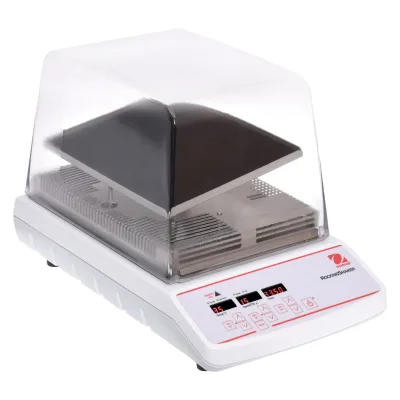
item number: 39976
List price € 3.400,00
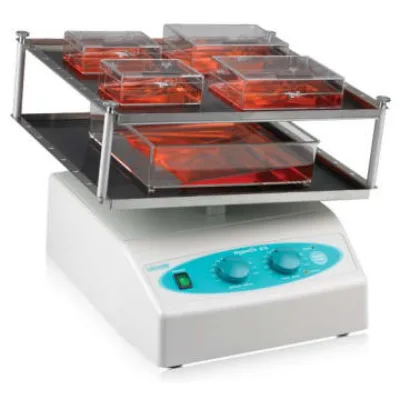
item number: 23765
Price on request
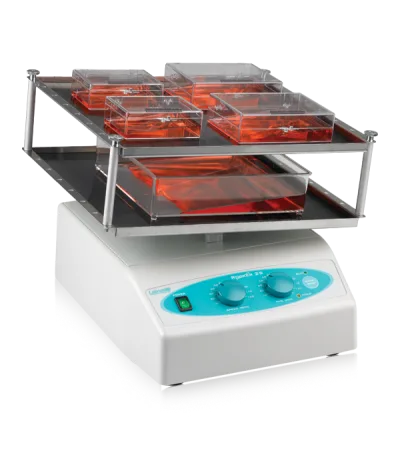
item number: 23757
Price on request
item number: 24641
Price on request
item number: 24678
Price on request
Rocking shakers and tumbling shakers are specialised laboratory shakers for the controlled movement of liquids in vessels or on plates. While rocking shakers perform a one-dimensional up-and-down motion, 3D shakers generate a three-dimensional movement. These devices are primarily used to ensure uniform wetting of surfaces without compromising the sample structure.
A central application area for models such as the ProBlot 25 is the staining and destaining of electrophoresis gels. For temperature-sensitive processes, incubation rocking shakers and incubation 3D shakers are available, covering a working range from ambient +5 °C to 65 °C. These devices combine mechanical mixing with precise temperature control of the sample chamber.
To increase throughput in the laboratory, variants such as the ProBlot 25-D or ProBlot 25-DXL offer a two-tier design. These multi-tier platforms double the usable surface area without requiring additional bench space. Platform sizes vary by model from compact 260 x 200 mm units to large 300 x 300 mm surfaces for larger sample volumes.
Here you will find answers to technical and application-related questions regarding shaking systems with rocking or tumbling functions.
These devices are used for the gentle mixing of samples. Typical applications include staining and destaining gels after electrophoresis, washing steps in blotting procedures, and the incubation of cell cultures or chemical reactions.
A rocking shaker moves the platform in a two-dimensional rocking motion, while a tumbling shaker performs a three-dimensional nutation movement. The 3D movement often ensures an even more uniform distribution of liquid across the entire surface.
Special incubation models such as the ISWV02HDG allow for temperature control of samples in a range from ambient +5 °C up to 65 °C, making them suitable for microbiological applications.
A two-tier design, such as on the ProBlot 25-D, doubles the capacity while maintaining the same footprint. This is particularly advantageous for laboratories with high sample volumes and limited bench space.
The range offers various dimensions, for example, compact platforms of 260 x 200 mm for standard applications or XL variants with 300 x 300 mm for larger vessels or multiple gels simultaneously.
Interested parties can submit an enquiry directly via the button for exclusive offers to receive project-specific pricing and information on available models.
Yes, rocking and tumbling shakers for laboratory use are designed for continuous operation to ensure constant shaking movements at stable temperatures over long periods.