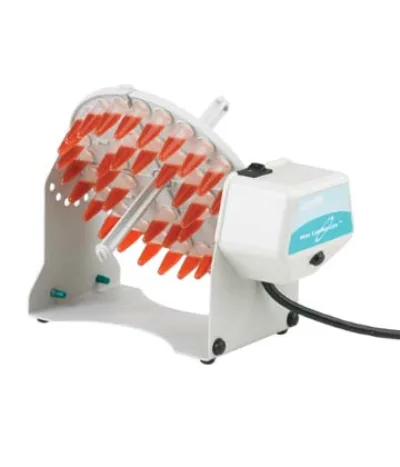
Mini Incubator with Mini LabRoller with Rotisserie for 50, 15 and 1.5 ml Tubes
item number: 27863
Complete system
Price on request

Inverted shakers are used in research, biotechnology, and diagnostics for the continuous mixing of samples. These devices enable controlled agitation of liquids in various vessel types.
item number: 27863
Price on request
In analytical chemistry and microbiology, inverted shakers are essential for the homogenisation of solutions. They are used to keep samples in tubes or other vessels in constant motion.
The range includes specialised solutions such as the mini incubator with mini lab roller. This complete system is designed for use with rotisseries and is suitable for samples in 50, 15, and 1.5 ml tubes.
Depending on the requirements, different device types are used. While inverted shakers are used for specific movement sequences, vortexers, tube rollers, or rocking or tumbling shakers offer alternative mechanical mixing methods for different vessel types.
For stable operation and secure sample retention, components such as test tube racks or spring clips can be used to secure the vessels during the shaking process.
Here you will find answers to the technical and practical aspects of this device class.
They are used for the continuous mixing or agitation of samples in liquid media, for example in cell culture or chemical extractions.
This depends on the selected system; special complete systems are designed for 1.5 ml, 15 ml, and 50 ml tubes, for example.
Inverted shakers perform specific agitation movements, while tube rollers mix samples through a rotating movement of the vessels.
In addition to inverted shakers, vortexers, orbital shakers, rocking or tumbling shakers, and shakers for microtitre plates are also used.
Depending on the vessel type, test tube racks or spring clips can be used to hold samples securely during operation.
For detailed specifications or an individual offer, you can view the corresponding product pages or make an enquiry.
Important factors include the required vessel sizes, the type of movement, and whether the system offers integrated functions such as incubation.