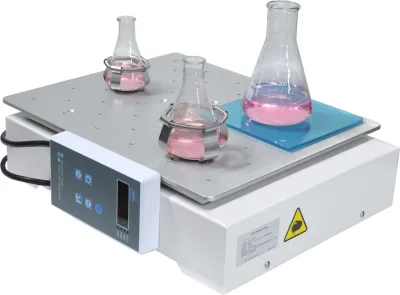
Crystal OSC-26M, Orbital Shaker for Operation in CO₂ Incubator
item number: 39961
Control unit and power supply are positioned outside the incubator.
€ 2.940,00
Promotional Price € 2.205,00

Circular and orbital shakers are used in laboratories, biotechnology, and research for the circular mixing of liquids, cell cultures, and suspensions. They are suitable for use on work surfaces as well as for installation in CO2 incubators and incubation chambers. Professional customers in pharma, diagnostics, and clinics use these devices for the reproducible cultivation and homogenization of temperature-sensitive samples.
item number: 39961
€ 2.940,00
Promotional Price € 2.205,00
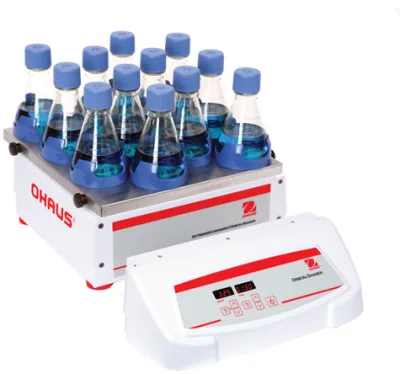
item number: 39557
List price € 4.660,00

item number: 39541
List price € 3.605,00
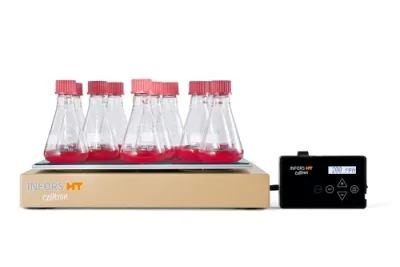
item number: 15881
Price on request
Circular and orbital shakers generate a circular motion, which is particularly suitable for the gentle mixing of cell cultures, suspensions, and liquids. This movement ensures uniform mixing without subjecting samples to strong mechanical stress. These shakers are used in biotechnology, pharmaceutical research, microbiological diagnostics, and cell culture. They are available as benchtop units and for operation in CO2 incubators and incubation chambers.
The range includes circular shakers for operation in CO2 incubators, where the control unit and power supply are placed outside the incubator. Furthermore, high-performance orbital shakers are available, designed for extreme environments with up to 100% humidity. Models with high capacity, such as 23 kg load, cover applications with larger sample throughput. Benchtop circular shakers with separate control units are flexibly suitable for incubators and incubation chambers. The devices differ in control, capacity, and suitability for climate-controlled environments.
Some circular and orbital shakers are specifically designed for use in CO2 incubators. The control unit is mounted outside the incubator to avoid affecting the temperature and atmosphere inside. Models for extreme environments with up to 100% relative humidity offer corrosion-resistant materials and sealed drives. These features are important for cell culture applications where controlled temperature, CO2 content, and humidity are critical.
The orbital shakers offered cover different loading capacities. High-performance models offer capacities of up to 23 kg and allow for the simultaneous processing of multiple Erlenmeyer flasks, Petri dishes, or culture bottles. The usable area and maximum load must be adapted to the respective sample quantity and vessel size. Analogue and digital controls allow for precise setting of speed and shaking stroke.
Circular and orbital shakers are available with analogue or digital control. Analogue devices offer simple, robust operation for standard applications. Digital models allow for exact speed setting, timer functions, and, in some cases, documentation of process parameters. The separate control unit on incubator models facilitates monitoring and adjustment without having to open the incubator. This reduces disturbances to culture conditions and increases reproducibility.
The following answers assist with the selection and use of circular and orbital shakers in the laboratory.
Circular and orbital shakers generate a circular motion and are used for the gentle mixing of cell cultures, suspensions, and liquids. Typical applications include the cultivation of microorganisms, cell lines in Erlenmeyer flasks, Petri dishes, or culture bottles, as well as the homogenization of samples in pharmaceutical research and biotechnology.
For operation in a CO2 incubator, models with a separate control unit and external power supply are suitable. This design prevents heat generation inside the incubator and allows for control from the outside. Some devices are also designed for high humidity up to 100% to work in a corrosion-resistant manner and not impair culture conditions.
The capacity depends on the number and size of the vessels as well as the sample quantity. High-performance models offer loading capacities of up to 23 kg and are suitable for multiple Erlenmeyer flasks or larger culture bottles. For high throughputs and extensive test series, devices with a large usable area and high load capacity are preferred.
Analogue controls are simple and robust but offer less precision and no documentation options. Digital controls allow for exact speed setting, timer functions, and, in some cases, the recording of process parameters. Digital models are useful for applications where reproducibility and traceability are important, such as in a GMP environment.
Useful accessories include holders and racks for different vessel sizes, such as Erlenmeyer flasks, Petri dishes, or culture bottles. Spring clamps and test tube racks secure the samples during operation. For use in incubators, special corrosion-resistant inserts and covers can be useful to reduce contamination and evaporation.
Quotes and advice can be requested via the laboratory equipment dealer. Relevant information for the request includes: area of application, vessel types and sizes, required loading capacity, use in incubators or under normal conditions, and the desired type of control. Professional advice helps to identify the suitable model for the specific need.
During installation in a CO2 incubator, the control unit must be placed outside to avoid heat generation inside. The device should be suitable for high humidity and be corrosion-resistant. Cable routing must be done in such a way that the tightness of the incubator door is not impaired. Before commissioning, the stability of the installation surface should be checked to avoid vibrations and disturbances to the cultures.