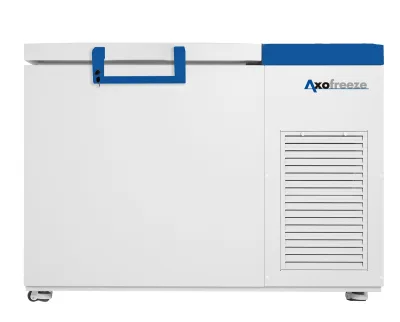
-150°C-Truhe Axofreeze MDF-150C138, 138 l Volumen, Kapazität 9.600 Proben, LCD Touchscreen
item number: 41001
Kapazität 96 Boxen mit 50 mm Höhe in 12 Racks
Price on request

-150°C ultra-low temperature chest freezers enable true cryopreservation without the need for liquid nitrogen. Below -130°C, water adopts a glass-like structure, causing all biological and chemical processes to cease completely. The range includes models from 118 to 258 litres with capacities ranging from 4,800 to 16,500 sample tubes.
item number: 41001
Price on request
item number: 41000
Price on request
The critical physical difference between -86°C and -150°C storage lies in the state of water: below approximately -130°C, water transitions into a glass-like (amorphous) state. Enzymatic reactions, oxidation processes, and crystal formation come to a complete standstill. At -86°C, these processes are significantly slowed but not fully halted—for storage over decades or for particularly sensitive cell materials, this temperature difference can be decisive.
The range includes three models: Innova MF-150H118P (118 l, 48 cryoboxes, 4,800 samples), Innova MF-150H258P (258 l, 165 cryoboxes, 16,500 samples), and Axofreeze MF-150H239 (239 l, 150 cryoboxes, 15,000 samples). All specifications apply to cryoboxes with a height of 50 mm. All units operate with mechanical cascade cooling and do not require liquid nitrogen—eliminating the logistics of refilling, evaporation losses, and the specific safety requirements associated with handling cryogens.
-150°C cryo-freezers are used for the long-term preservation of stem cells and induced pluripotent stem cells (iPSC), cell lines for CAR-T and other cell therapy programmes, germ cells and embryos in reproductive medicine, and for biobanks with a long-term horizon of over 10 years. For GMP-regulated applications, qualification (IQ/OQ/PQ) and connection to a continuous temperature monitoring system are recommended.
Why -150°C instead of -86°C, which capacities are available, and what are the advantages of mechanical cooling over liquid nitrogen—an overview of the most important questions regarding -150°C cryo-freezers.
Below -130°C, water adopts a glass-like (amorphous) structure—enzymatic reactions, oxidation processes, and ice crystal formation come to a complete standstill. At -86°C, these processes are significantly slowed but not fully stopped. For stem cells, iPSC lines, cells for cell therapy programmes, and long-term storage over decades, -150°C is the safer choice.
-150°C cryo-freezers with mechanical cascade cooling do not require liquid nitrogen. This eliminates refilling logistics, evaporation losses, special safety requirements for handling cryogens, and dependence on nitrogen supply. Operation is possible with a standard power connection.
The range includes three models: Innova MF-150H118P (118 l, 48 cryoboxes, approx. 4,800 samples), Innova MF-150H258P (258 l, 165 cryoboxes, approx. 16,500 samples), and Axofreeze MF-150H239 (239 l, 150 cryoboxes, approx. 15,000 samples). All specifications apply to cryoboxes with a height of 50 mm.
Typical applications include the long-term preservation of stem cells and iPSC lines, cell lines for CAR-T and other cell therapy programmes, germ cells and embryos in reproductive medicine, and biobanks with a long-term horizon. In GMP environments, qualification (IQ/OQ/PQ) is required.
For seamless temperature documentation, an external WLAN data logger with alarm forwarding is recommended, which alerts via email or SMS if limits are exceeded. In GMP environments, continuous recording is a prerequisite for regulatory compliance.