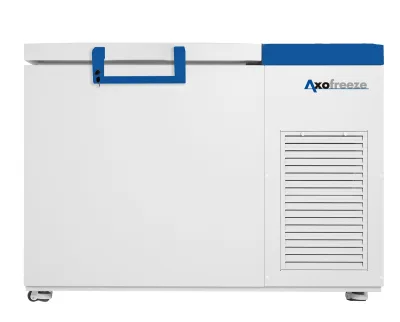
-150°C-Truhe Axofreeze MDF-150C138, 138 l Volumen, Kapazität 9.600 Proben, LCD Touchscreen
item number: 41001
Kapazität 96 Boxen mit 50 mm Höhe in 12 Racks
Price on request

Ultra-low temperature chest freezers with temperature ranges from -86°C to -150°C ensure the long-term storage of biological samples with particularly high temperature stability. Because cold air remains inside the unit when the lid is opened, temperature fluctuations are lower than in upright freezers. The range includes -86°C chest freezers from Fryka and Elcold (90 to 300 litres) as well as -150°C cryo-freezers from Axofreeze and Innova (118 to 258 litres).
item number: 41001
Price on request
item number: 41000
Price on request
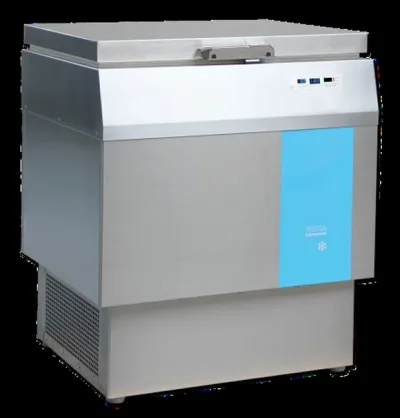
item number: 15285
List price € 7.675,00
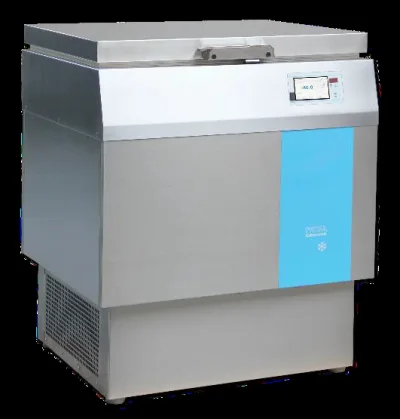
item number: 15286
List price € 8.490,00
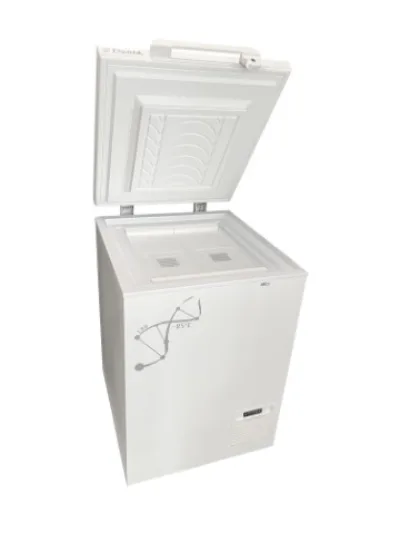
item number: 39479
List price € 6.610,00
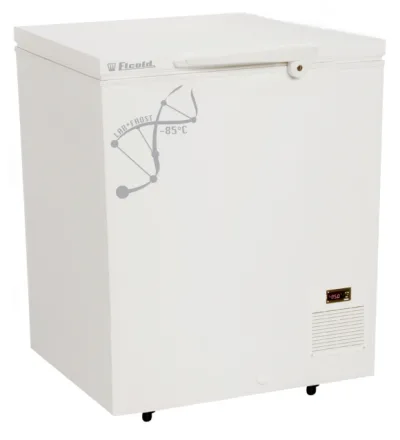
item number: 17582
List price € 6.745,00
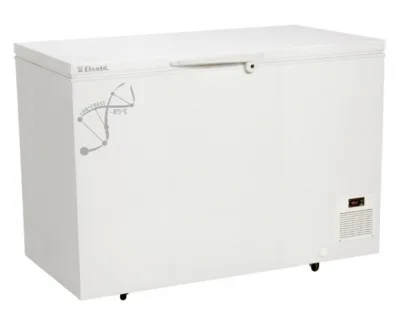
item number: 17583
List price € 7.790,00
Ultra-low temperature chest freezers operate using the same cascade principle as -86°C upright freezers but offer a design-related advantage: when the chest is opened, cold air sinks and largely remains inside the interior. This results in lower temperature fluctuations, which reduces the thermal stress on stored samples. This makes chest freezers particularly suitable for storing large sample collections that are accessed infrequently.
-86°C chest freezers cover the standard ULT range and are suitable for storing DNA, RNA, proteins, cell lines, microorganisms, and enzyme preparations. The range includes the Fryka TT 85-90 (90 l, max. 72 cryoboxes 2, 4.45 kWh/24h) and Elcold LAB models from 92 to 300 litres (max. 216 cryoboxes, 5.8 to 8.5 kWh/24h). Several models are available with an integrated data logger.
Below -130°C, water transitions into a glass-like state — all chemical and biological processes come to a complete standstill. This state of maximum long-term stability is achieved with -150°C cryo-freezers without the logistical effort and safety requirements of liquid nitrogen. The range includes the Axofreeze MF-150H239 (239 l, 150 boxes, 15,000 samples), Innova MF-150H258P (258 l, 165 boxes, 16,500 samples), and MF-150H118P (118 l, 48 boxes, 4,800 samples). Typical applications include the cryopreservation of stem cells, cell lines for CAR-T therapies, and long-term biobanking.
For GMP-compliant operation, we recommend supplementing the units with external or integrated data loggers with alarm forwarding. Axon supplies suitable WLAN data loggers and alarm forwarding systems for ULT devices.
We have compiled the most important questions regarding the selection, technology, and use of ultra-low temperature chest freezers here — from choosing between a chest and an upright freezer to the differences between -86°C and -150°C cryo-storage.
In a chest freezer, cold air remains inside when the lid is opened because cold air is heavier than warm air. In an upright freezer, cold air flows out when the door is opened. Consequently, chest freezers offer lower temperature fluctuations during access, whereas upright freezers allow for faster access to individual positions.
-86°C ultra-low temperature chest freezers are suitable for the long-term storage of DNA, RNA, proteins, enzymes, cell lines, microorganisms, and tissue samples. From -70°C, biological processes largely come to a halt, enabling stable storage over months and years.
Below -130°C, water transitions into a glass-like state — all enzymatic and chemical processes come to a complete standstill. For particularly sensitive materials such as stem cells, iPSC lines, or cells for cell therapy programmes, as well as for long-term storage over decades, -150°C is the more suitable choice.
Yes. For GMP-compliant operation, qualification (IQ/OQ/PQ) based on manufacturer documentation is required. Seamless temperature monitoring is carried out via integrated or external data loggers with alarm forwarding via WLAN, email, or SMS.
Capacity depends on the volume and box size. Available models hold between 34 cryoboxes (Elcold LAB 8, 92 l) and 216 cryoboxes (Elcold LAB 31, 300 l) in the 2-inch format at -86°C, or 48 to 165 boxes for the -150°C models.